
Remote Work vs Work From Home: Differences, Benefits & Complete Guide
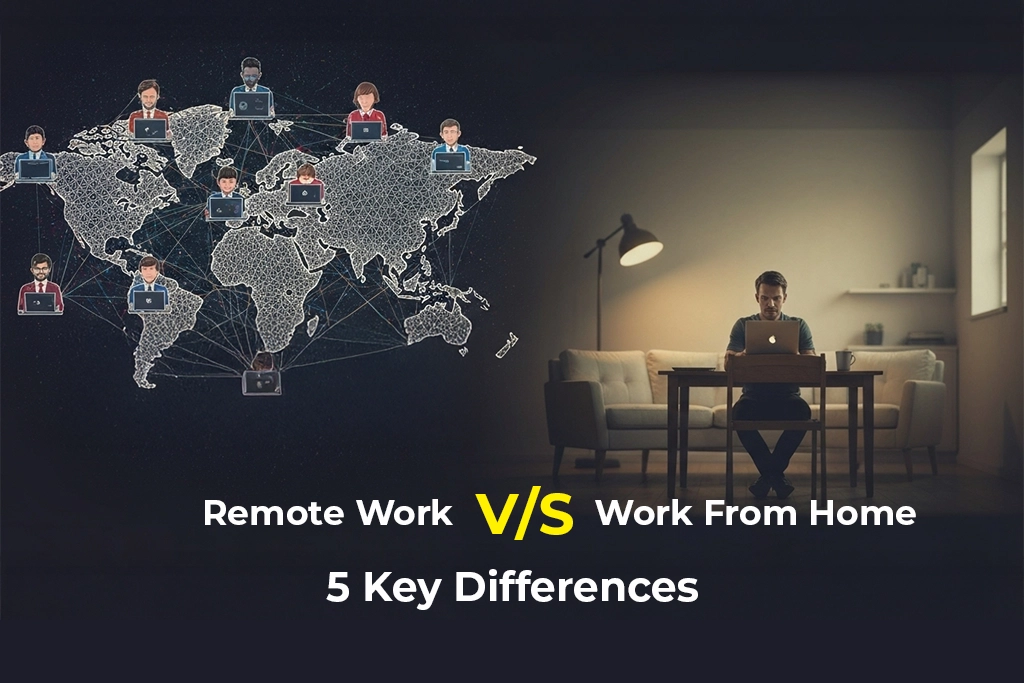
Many people use the terms “remote work” and “work from home” interchangeably, but they’re actually quite different. Understanding these differences is crucial for both employees and employers when deciding which work model fits best. As flexible work becomes the norm, understanding the difference between remote work and work from home is essential. While both offer flexibility, they differ in location freedom, structure, collaboration, and management.
Quick Definition: Remote Work vs Work From Home
While these terms are often used the same way, they have distinct meanings:
Remote Work: A flexible work arrangement where employees work from any location—home, café, coworking space, or while traveling—without being tied to a physical office.
Work From Home: A specific type of remote work where employees work exclusively from their home. It’s a subset of remote work, not the entire category.
Key Differences Between Remote Work and Work From Home
Here are the main differences that matter for employees and managers:
| Factor | Remote Work | Work From Home |
| Location | Any location: home, café, coworking space, while traveling | Home only |
| Flexibility | Maximum flexibility—change location daily | Fixed to home location |
| Setup | Minimal setup—laptop usually sufficient | Full home office setup required |
| Office Visits | Rare or occasional | None or very rare |
| Team Dynamics | Often scattered across time zones | May be locally based |
Remote Work: Definition, Benefits & Challenges
What is Remote Work?
Remote work is an employment model where employees are not required to work from a physical office location. Instead, they work from any location with an internet connection. Remote work became mainstream during the COVID-19 pandemic but has evolved into a permanent option for many companies.
Benefits of Remote Work
- Maximum flexibility: Work from home, coffee shops, libraries, or while traveling
- Access to global talent: Companies can hire the best candidates worldwide, not just locally
- Reduced commute costs: No daily travel means saving on gas, parking, and public transportation
- Better work-life balance: Flexibility to manage personal and professional responsibilities
- Increased productivity: Fewer office distractions for focused, deep work
- Cost savings for employers: Reduced office space, utilities, and facilities expenses
Challenges of Remote Work
- Communication difficulties: Harder to build relationships without in-person interaction
- Isolation: Lack of face-to-face collaboration can lead to loneliness
- Time zone complications: Managing meetings across different time zones is complex
- Work-life boundaries: Difficult to “switch off” when your home is your office
- Technology dependency: Relies heavily on internet connection and digital tools
- Distractions at location: Coffee shops and public spaces can interrupt focus
Work From Home: Definition, Benefits & Challenges
What is Work From Home?
Work from home (WFH) is a specific remote work arrangement where employees work exclusively from their home. Unlike remote work, which allows flexibility in location, work from home is location-fixed. This model became popular pre-pandemic but accelerated dramatically in recent years.
Benefits of Work From Home
- Dedicated workspace: Your own office designed for productivity and comfort
- Consistency: Same environment every day creates routine and structure
- Family time: Easier to be present during breaks and lunch
- Customization: Control over lighting, ergonomics, and environment
- Reduced commute stress: Save time and money on daily transportation
- Privacy: Control over who enters your workspace during work
Challenges of Work From Home
- Isolation: Limited social interaction and team connection
- Home distractions: Family, pets, chores, and household responsibilities interrupt work
- Blurred boundaries: Hard to separate personal and professional life
- Career visibility: Less interaction with management and decision-makers
- Home office costs: Requires investment in furniture, internet, and setup
- Missed informal learning: No spontaneous knowledge sharing from proximity to colleagues
Hybrid Work Models: Combining Both Approaches
Many companies now use hybrid models that blend remote and in-office work. These include:
2 Days Office, 3 Days Home
Employees work from home most days but come to the office for meetings and collaboration 2 days per week. This balances focus time with team connection.
Remote-First with Quarterly Office Days
Employees work remotely full-time but visit the office once or twice per quarter for team bonding and strategic planning.
Flexible Hybrid
Employees can choose where to work each day based on their tasks and personal needs, with no fixed schedule.
Which Model is Right for You?
Choose Remote Work If…
- You value maximum flexibility and freedom of location
- You travel frequently or want to work from different locations
- You’re independent and self-motivated
- You work well with asynchronous communication
- You want minimal office visits
Choose Work From Home If…
- You need a dedicated, stable workspace
- You prefer structure and clear work-life separation
- You have family or household responsibilities
- You need a comfortable, customized work environment
- You want to avoid commuting
Choose Hybrid Work If…
- You want the best of both worlds
- You value team collaboration and in-person connection
- You need flexibility some days but focus time others
- You want the option to work from home when needed
Tools for Managing Remote and Work From Home Teams
Regardless of which model you choose, the right tools are essential for success:
1. Time Tracking & Productivity Tools
Tools like ProHance and Time Doctor help managers understand how team members spend their time, provide visibility into productivity, and generate detailed reports. These tools work for both remote and work-from-home teams.
2. Communication Platforms
Slack, Microsoft Teams, and Zoom enable real-time communication, video calls, and instant messaging across distributed teams.
3. Project Management Tools
Asana, Monday.com, and Trello keep projects organized, assign tasks, track progress, and ensure everyone knows their responsibilities.
4. Document & File Sharing
Google Workspace, Microsoft 365, and Dropbox enable seamless document sharing, collaboration, and version control.
5. VPN & Security Tools
VPNs and security software protect data when working from various locations, especially important for remote workers in public spaces.
Conclusion: Choosing Your Work Model
Remote work and work from home are not the same thing, and understanding the difference is crucial for making the right decision for your career or company.
Remote work offers maximum flexibility and location freedom, ideal for those who value travel, variety, and adaptability. Work from home provides structure, a dedicated workspace, and clear boundaries between personal and professional life.
Many organizations are finding that hybrid models offer the best of both approaches, allowing employees to enjoy flexibility while maintaining team connection and collaboration.
The key to success in any model is having the right tools, clear communication expectations, and a culture that supports distributed work. Whether you choose remote, work from home, or hybrid, investing in proper infrastructure and management practices will determine your success.
Frequently Asked Questions
Is remote work the same as work from home?
No. Work from home is a subset of remote work. Remote work includes any non-office location (home, café, library, traveling), while work from home is strictly from your home.
Which is better for productivity: remote or work from home?
It depends on the individual. Work from home offers a dedicated, controlled environment for focus. Remote work offers flexibility but can have distractions. Research shows both can be equally productive when managed properly.
Can employers require employees to come to the office in a remote work arrangement?
Yes. Many remote work policies include occasional in-office days for team meetings, onboarding, or company events. However, these should be clearly defined in the employment agreement.
Is remote work safe for data security?
Yes, if proper security measures are in place: VPNs, encryption, two-factor authentication, and regular security training. Employees should avoid public WiFi for sensitive work or use VPNs when necessary.
How do companies maintain culture in remote work environments?
Through virtual team events, regular communication, clear company values, periodic in-person gatherings, mentorship programs, and recognition of achievements. Culture requires intentional effort in remote settings.
Is hybrid work the future?
Likely yes. Research shows hybrid models satisfy both employee preferences (flexibility) and employer needs (collaboration). Many companies view hybrid as the optimal long-term strategy.
Learn how ProHance can help

Shikha Mishra
Shikha is a seasoned journalist and PR professional with over 20 years of experience. She has written for prestigious publications such as The Hindustan Times, Times of India, and Gulf News. She specializes in writing, editing, Public Relations and Corporate Communications. Shikha also excels in digital and traditional marketing, social media, and brand building.
