
Productivity Management: Benefits, Best Practices & Measurement Tips

Table of contents
- What is productivity management?
- Understanding Productivity: Output Versus Input
- Why Productivity Management Is Critical in Modern Workplaces
- Importance and Benefits of Productivity Management
- How Employee Productivity Management Drives Business Success
- Popular Productivity Management Tools and Software
- Effective Methods to Measure and Enhance Productivity in the Workplace
- Productivity Management Techniques to Keep Your Teams Productive
- Productivity Management Challenges and How to Overcome Them
- Productivity Management vs Time Tracking: Key Differences
- Conclusion
- Frequently Asked Question
Productivity management is one of the most important responsibilities of modern managers. When done right, it can increase team output by 30-50%, improve employee satisfaction, and help your company grow faster. This complete guide shows you how to implement productivity management, measure results, and build a high-performing culture.
What is Productivity Management?
Productivity management is the practice of planning, organizing, and monitoring work activities to ensure employees complete their tasks efficiently and effectively.
It’s not about working harder or longer—it’s about working smarter. Productivity management helps you understand how time is spent, identify bottlenecks, and create systems that help people do their best work. Think of it as the strategy that turns potential into performance.
Key Components of Productivity Management
- Goal setting: Clear objectives that align with business strategy
- Planning: Organizing work and allocating resources effectively
- Monitoring: Tracking progress and identifying issues early
- Feedback: Regular communication about performance
- Optimization: Continuous improvement based on data
- Support: Resources and training to help teams succeed
Why Productivity Management Matters for Your Business
Every business has the same resource constraint: time. The difference between successful companies and struggling ones is often how well they manage that time. Here’s why productivity management matters:
The Cost of Poor Productivity
- Organizations lose $1.7 million annually per 100 employees to wasted time
- Less than 60% of paid work hours actually contribute to productivity
- Unclear priorities lead to wasted efforts and rework
- Poor productivity management increases employee burnout
- Managers can’t identify high performers or struggling employees
Productivity management solves all of these problems. When you have visibility into how work gets done, you can make smarter decisions that actually move the needle.
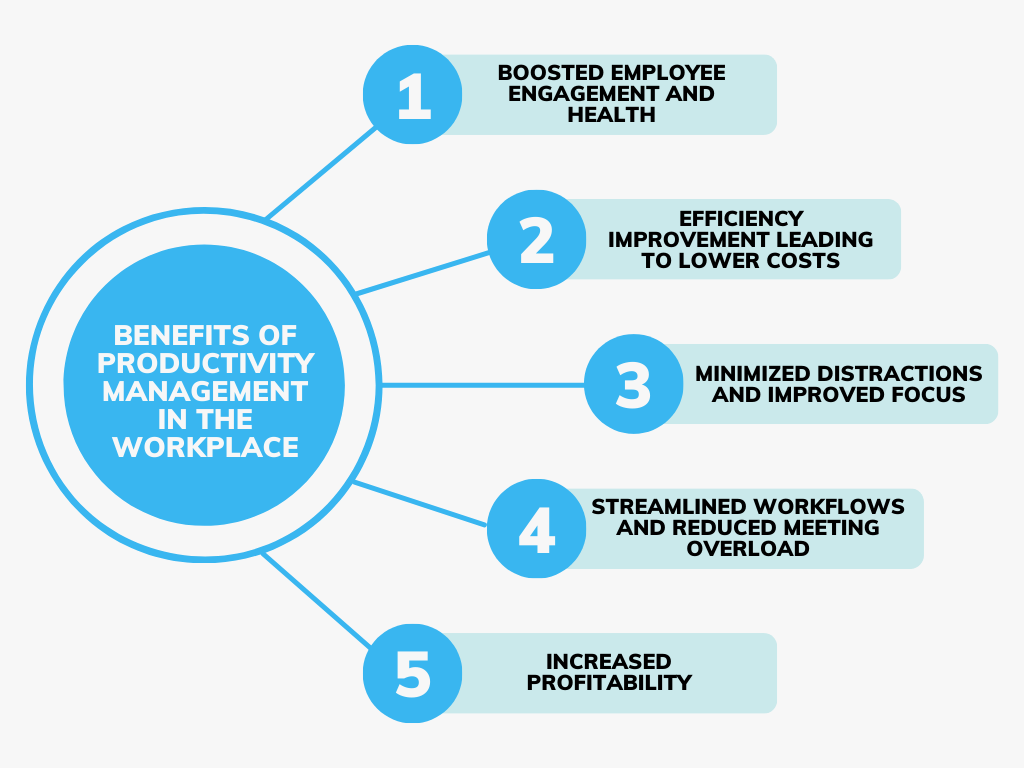
8 Key Benefits of Effective Productivity Management
Benefit 1: Increased Output and Revenue
When employees work efficiently, they complete more tasks, serve more customers, and drive more revenue. Companies using effective productivity management report 30-50% increases in output.
Benefit 2: Better Resource Allocation
You see exactly where your team’s time goes. This lets you reallocate people from low-value to high-value work. Some companies find that 20% of their budget could be redirected to more impactful initiatives.
Benefit 3: Reduced Burnout and Turnover
Burnout happens when people feel overwhelmed, unclear about expectations, or invisible. Productivity management provides clarity, reduces unnecessary stress, and helps people succeed. This directly reduces turnover and retention costs.
Benefit 4: Improved Quality
When people aren’t rushing or juggling too many tasks, they do better work. Productivity management helps balance workload so everyone can focus on quality, not just speed.
Benefit 5: Data-Driven Decision Making
Instead of guessing who’s productive or which projects matter most, you have data. This leads to better hiring, better project prioritization, and better management decisions.
Benefit 6: Faster Problem Identification
Productivity management reveals problems before they become crises. Low productivity on a project? You spot it in week 1, not week 8. Process bottleneck? Visible immediately.
Benefit 7: Better Collaboration
Clear visibility into who’s working on what helps teams coordinate better, reduce duplication, and work together more effectively.
Benefit 8: Competitive Advantage
Companies with good productivity management move faster than competitors. They deliver products sooner, respond to market changes quicker, and innovate more effectively. This builds long-term competitive advantage.
How to Implement Productivity Management: Step-by-Step
Implementing productivity management doesn’t require expensive software or complex processes. Follow these steps to get started:
Step 1: Set Clear Goals
Employees can’t be productive if they don’t know what they’re supposed to accomplish. Define SMART goals (Specific, Measurable, Achievable, Relevant, Time-bound) for each person and team. Ensure these align with business strategy.
Step 2: Define How Work Gets Done
Create workflows and processes that guide your team. What are the steps to complete a project? What decisions need to be made? Who approves what? Clarity prevents confusion and wasted time.
Step 3: Choose Tools to Track Progress
You don’t need surveillance—you need visibility. Use project management tools (Asana, Monday), time tracking software (ProHance, Time Doctor), or simple status update systems. The goal is understanding progress, not spying.
Step 4: Establish Regular Check-Ins
Meet weekly with your team members. Use these meetings to discuss progress, identify blockers, celebrate wins, and provide support. This is your opportunity to manage productivity while building relationships.
Step 5: Monitor and Measure
Track the metrics that matter (see section on metrics below). Are people hitting their goals? Is the quality good? Are projects on schedule? What’s causing delays? This data guides your next steps.
Step 6: Provide Support and Coaching
If someone’s productivity is low, that’s a signal to help, not punish. They might be stuck, confused, overwhelmed, or facing personal challenges. Productivity management means helping people succeed.
Step 7: Optimize Based on Data
Look at your productivity data. What’s working? What’s not? Make changes to processes, workload distribution, tools, or team structure based on what the data shows, not gut feel.
Step 8: Review and Adjust Regularly
Productivity management is continuous. Review your approach monthly. What’s improved? What still needs work? Adjust your goals, processes, and tools based on results.
Essential Metrics to Measure Productivity
You can’t manage what you don’t measure. Here are the key metrics to track:
| Metric | What It Measures | Why It Matters |
| Output Quality | Errors, rework, customer satisfaction | Productivity isn’t just speed—quality matters |
| Time Allocation | Hours spent on different tasks/projects | Reveals wasted time and misalignment |
| Goal Completion | % of goals achieved on schedule | Shows whether people deliver results |
| Project Timeline | On-time vs delayed delivery | Indicates whether deadlines are realistic |
| Employee Engagement | Satisfaction, retention, burnout signs | Productivity depends on engaged team |
Tools for Productivity Management
The right tools make productivity management easier. Here are the main categories:
Project Management Tools
- Asana, Monday.com, Trello – Track task progress and project timelines
- Best for: Seeing what people are working on and when it’s due
Time Tracking Software
- ProHance, Time Doctor, Toggl – Track hours and time allocation
- Best for: Understanding where time is actually spent
Communication Tools
- Slack, Microsoft Teams – Centralize communication and collaboration
- Best for: Reducing email and creating transparency
Productivity Analytics
- ProHance Workforce Analytics – Deep insights into team productivity
- Best for: Data-driven decision making and optimization
Common Productivity Management Mistakes
Avoid these common errors when implementing productivity management:
Mistake 1: Treating Productivity Management as Surveillance
If your team sees productivity management as spying, trust breaks down. Frame it as a tool to help them succeed, not to catch them slacking.
Mistake 2: Measuring the Wrong Metrics
Hours logged ≠ productivity. Focus on output, quality, and goal achievement—not activity. A person working 6 focused hours might be more productive than someone working 10 distracted hours.
Mistake 3: Setting Unrealistic Expectations
If you expect 100% productivity all day, people will burn out. Plan for meetings, unexpected issues, learning, and breaks. Typically, 60-70% of work hours on actual focused tasks is realistic.
Mistake 4: Not Following Up on Data
If you collect productivity data but never act on it, people lose trust and stop caring. Use data to make changes: reallocate workload, improve processes, provide support.
Mistake 5: Ignoring Employee Feedback
Employees know obstacles preventing them from being productive. Listen to their input. Maybe they need better tools, clearer priorities, or different workflows.
Mistake 6: Not Celebrating Successes
Productivity management is about building momentum. Celebrate when people hit goals, complete projects, and improve. Positive reinforcement is as important as feedback about problems.
Conclusion: Making Productivity Management Work
Productivity management is one of the most powerful tools in a manager’s toolkit. When implemented correctly, it increases output, improves quality, reduces burnout, and builds a high-performing culture.
The key is doing it with honesty, transparency, and a genuine commitment to helping your team succeed. It’s not about surveillance. It’s about creating the conditions where people can do their best work.
Start simple. Set clear goals. Have regular check-ins. Track metrics that matter. Act on what you learn. Celebrate wins. Build from there.
The companies winning in today’s competitive environment are the ones that help their people be productive. This competitive advantage compounds over time. Six months from now, a team with good productivity management will have delivered significantly more than a team without it.
FAQs
How is productivity management different from employee monitoring?
Monitoring is about surveillance—watching what people do. Productivity management is about outcomes—ensuring people achieve results. Good productivity management is collaborative and supportive, not adversarial.
Does productivity management require expensive software?
No. You can start with simple tools: weekly check-in meetings, project management software you might already have (like Trello), and basic metrics tracking in a spreadsheet. Software helps scale it, but it’s not required.
How often should I measure productivity?
Weekly for team-level metrics, monthly for deeper analysis, and quarterly for strategic decisions. Daily metrics create stress and false precision. Monthly is usually the right balance.
What if my team resists productivity management?
They might resist because they see it as surveillance or they worry about being judged. Address this by being transparent about your goals. Frame it as helping them succeed, not as control. Involve them in choosing metrics and tools.
How do I balance productivity management with flexibility?
Focus on results, not processes. If someone delivers quality work on time, the specific hours they worked or how they organized their day matters less. Flexibility in how people work with accountability for results is the winning formula.
Can productivity management improve employee satisfaction?
Yes. When done well, it removes ambiguity, provides support, and creates fair evaluation. People know what’s expected, they know how they’re doing, and they feel supported. This increases satisfaction and engagement.
Learn how ProHance can help

Abhishek Tahlan
Abhishek is a marketing professional with more than 7 years of experience in the field of digital marketing. He has worked in various senior marketing roles across a wide variety of organizations and industries, including EdTech and Tech.
